Showing posts with label phonemes. Show all posts

Wednesday, September 21, 2011

Smoking Hot Phonemes /θænk ju:/

From a 22 Words post titled "Phonetically Accurate Gratitude"


“OK, so it’s actually not quite accurate since the T-H is voiced in “than” but not in “thank,” but close enough.”

I love that 22 Words noticed the voicing.

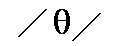
theta is voiceless


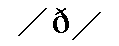
eth is voiced


To add further phonetic analysis, the way the sign is written the individual words would read as /ðæn/ and /kju:/
when in reality the expression of gratitude is a combination of the words
/θænk/
and /ju:/

Wednesday, May 18, 2011

Phonemes Count and Phoneme Counts

The English language has 44 phonemes for most speakers*.
.


What, exactly does that mean?

Well, compare that number to the number of phonemes in other languages. For example, some languages in Africa have more than 100 phonemes and the Hawaiian language has only 13 phonemes.

According to some recent phonetic analysis conducted by University of Aukland psychologist Quentin Atkinson, places more recently settled by humans have fewer phonemes.

Very interesting, I thought.

*The number of phonemes for individual speakers in any language varies slightly with different dialects.


Data from an article in The Week.

Wednesday, April 14, 2010

Phonetics Lessons with Homer Simpson

Having previously posted about words that the television show The Simpsons has contributed to our lexicon I was thrilled to see a link on Fritinancy to an article about the Simpsons greatest language contribution. What I found most interesting in the article is the following:

"In the French version of the show Homer actually says 'T'oh!', instead of "D"oh!". This is because the French actor who dubs Homer"s voice misread the word the first time he played the role and has never got round to correcting himself."

I guess the actor must have been losing his voice that day.


.

In phonetics /t/ is the voiceless counterpart of /d/.

Click here for more about voicing.

Monday, March 8, 2010

Playing with Liquids - Use Your Manners


As a matter of fact, this may be one of the best mugs I have ever seen for a phonetician (or should I say...as a manner of articulation).


Spotted at cafepress.com

Wednesday, November 11, 2009

Phonemetry - The Schwa

Phoneme + Poetry = poetry about phonemes

A curvaceous young phoneme called schwa
Said "I never feel strong. It's bizarre!
I'm retiring and meek
And I always sound weak
But in frequency counts - I'm the star!"


I saw this poem while looking for additional IPA resources for my students. I immediately fell in love with it and thought I would share it with my readers.

P.S. The portmanteau is my creation.

Monday, October 5, 2009

Differentiating Between Phonemes - Theta and Eth

While teaching my class last week I was looking for a better way to illustrate the difference between the "theta" and "eth" phonemes because they are particularly hard for some people to differentiate.

I came across a wonderful post on Notes from a Linguistic Mystic that I have excerpted below:


A Tale of Two TH’s

Say “This thistle” a few times. Now, pay very close attention to the TH sounds at the beginning of each word. Put your hand on your Adam’s Apple (or equivalent area on your neck) while you say them. After a few tries, you’ll notice that, in the words of a friend of mine, the “TH” in “This” is “more buzzy”, or, put more scientifically, voiced. This sound, the TH in “This, That, The, There, Then, Those…”, is called an Eth (pronounced with a voiced, Eth sound). In the International Phonetic Alphabet (IPA), it has this symbol:


The TH in “thistle”, or “theater, theory, think, thought, throw, through…” is called a Theta, and is Eth’s voiceless counterpart (Theta is to Eth as T is to D). Theta’s IPA symbol is, shockingly, a theta, as shown here: Aside from voicing, there is no difference between them. The sounds are produced with the tongue in the same position, the tongue is doing the same thing for both, and all the other various phonetic phactors (I couldn’t resist) are the same. The only difference between the the Theta and the Eth is vocal fold vibration, but what a difference it makes.

-Thank you Linguistic Mystic, this is one of the pest (Oops, I meant to say 'best' but I temporarily lost my voice) examples I have seen.

Wednesday, June 4, 2008

Eric Clapton in Japanese

While checking out a blog called "Who? Wot! Me?,"
I came across this picture with the caption "What do Japanese people really think of Eric Clapton?"

I, personally, am a big fan of Eric Clapton's music, but I still found humor in this Japanese attempt at spelling his name in English. There is, however, a very valid reason that the Japanese would spell Clapton's name as such and that is: the Japanese language does not have the "l- sound." Actually, the /l/ phoneme, as it is called, is unique among American English speech sounds.

The /l/ phoneme is classified as a sonorant approximant liquid by phoneticians - as is the /r/ phoneme. Although the /l/ and /r/ phonemes do have articulatory differences, many non-native American English speakers have difficulties differentiating between the two. These difficulties result in non-native speakers of English most frequently replacing the English /l/ phoneme with the /r/ phoneme.

This is why the Japanese pronounce Eric Clapton as Eric Crapton, not necessarily because they don't care for his music.
Related Posts Plugin for WordPress, Blogger...