Peter Dinlage in
The Station AgentErik Estrada in The Final Goal

Jack Donner in
The InstrumentIn Linguistics, referring to the argument structure of a verb is a method for describing the number and type of arguments a particular verb requires.
For example; the verb put, syntactically requires three arguments: a subject, an object and an indirect object. Semantically, put requires that the subject be animate because an inanimate entity is not capable of volition.
John put the book on the table.
The semantic requirements for the arguments of a verb are identified by assigning a certain number and type of theta role to verbs. All verbs have selectional restrictions encoded that supply the semantic relations between a verb and its arguments.
Another example is the verb walk. Walk only requires one argument, a subject, and again the subject must be animate.
John walked.
Following is a list of some of the more common theta roles with credit to
UNC.
AGENT
• argument who performs the action or brings about the state of affairs
• an agent is conscious, sentient, animate
• volition or purpose involved in the action being done
• the agent is the prototypical subject (but does not need to appear as a subject!)
e.g. Napoleon conquered much of Europe.
The cake was baked by my mother.
The cat peed all over the house.
INSTRUMENT
• argument involved in the action (but not the agent)
• can be used by an agent
• non-purposeful, non-volitional by itself
e.g. This key opens the office door.
The thieves used a pick-axe to get inside.
Robin ate the cereal with a spoon.
CAUSE
• argument involved in the action/in bringing about the state of affairs (but not the agent)
• cannot be used by an agent
• non-purposeful, non-volitional by itself
e.g. An epidemic killed most of the villagers.
London was devastated by the fire of 1666.
The Great Depression put thousands of Americans in poverty.
EXPERIENCER
• argument that undergoes a sensory, cognitive, or emotional experience
• must be animate/sentient
e.g. Teresa had never seen the ocean before.
Many people fear snakes.
His singing struck her as singularly terrible.
RECIPIENT
• arguments that receive something (good or bad) in a situation
e.g. They gave all the employees a raise.
I paid my landlord the rent.
He spared me his usual sob story.
THEME
• thing acted upon, moved, or otherwise affected by a situation, OR
• an argument which has a property being referred to
• prototypical direct object (but doesn’t have to be a direct object!)
• the “catch-all” (trashcan) of theta-roles
e.g. Napoleon conquered much of Europe.
Pat is very polite.
We put the books on the shelf.
London was devastated by the fire of 1666.
SOURCE
• the starting point for a movement
• may also indicate where a change (etc.) starts from
e.g. The package arrived from Moscow this morning.
I biked from Carrboro to Durham last night.
Robin frightened me.
GOAL
• the end point for a physical movement
• may also indicate the end result of a change in possession or identity
e.g. Many actors move to New York.
The magician changed the rabbit into a penguin.
John gave the cake to Mary.
LOCATION
• the place where an action occurred
e.g. We put the books on the shelf.
Maria sent a package to France.
Lots of good bands always come to Cat’s Cradle.
Returning to the example sentence John put the book on the table, the theta roles are as follows:
John (subject) = agent
the book (direct object) = theme
the table (indeirect object) = location
*It should be noted that some linguists use the terms thematic relations and theta roles interchangeably.

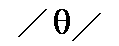
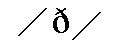
 Aside from voicing, there is no difference between them. The sounds are produced with the tongue in the same position, the tongue is doing the same thing for both, and all the other various phonetic phactors (I couldn’t resist) are the same. The only difference between the the Theta and the Eth is vocal fold vibration, but what a difference it makes.


 “OK, so it’s actually not quite accurate since the T-H is voiced in “than” but not in “thank,” but close enough.”