 Image from nfp2.co.uk
Monday, August 30, 2010

Friday, August 27, 2010

Wednesday, August 25, 2010
Stieg Larsson's Linguistic Riddle
I just finished reading Stieg Larsson's The Girl Who Kicked the Hornets Nest and I was intrigued by the linguistic riddle regarding the word "Amazon" that he presented on page 147 of the hardcover edition. While I realize the book is a work of fiction, there does seem to be some linguistic validity to this "riddle".
The riddle, according to Larsson, is whether the prefix "a-" means "without" in Greek or whether it means the opposite, "with".
In other words, is an Amazon a female warrior with or without breast?
Classic Greek mythology presents the tradition of Amazons destroying the right breast so as not to interfere with the use of the bow; however Larsson's book claims it has also been suggested that "an Amazon was a woman with especially large breasts."
Here is the relevant part of the entry for "Amazon" from an on-line edition of the Oxford English Dictionary (accessed through a private account):
1. pl. A race of female warriors alleged by Herodotus, etc. to exist in Scythia.
1398 TREVISA Barth. De P.R. XV. xii. (1495) 492 They were callyd Amazones, that is vnderstonde wythout breste.
1398 TREVISA Barth. De P.R. XV. xii. (1495) 492 They were callyd Amazones, that is vnderstonde wythout breste.
And the etymology:
[a. L. Amazon, a. Gr. ,*****; explained by the Greeks from * priv. + ***** a breast (in connexion with the fable that they destroyed the right breast so as not to interfere with the use of the bow), but prob. pop. etym. of an unknown foreign word.] (asterisks indicate unavailable font)
However, considering that there is no record of Amazons being without a right breast in works of art and all of the available images of Amazon warriors on a Google image search show women with both breasts, I have to believe that one of the other proposed etymologies for the word is more accurate.
Friday, August 20, 2010

Wednesday, August 18, 2010
McDonald's Contradiction

There is a logical discrepency in the above sign.
Logically one can not park and drive-thru at the same time.
Monday, August 16, 2010

Friday, August 13, 2010

Wednesday, August 11, 2010
Word Play Poetry
See if you can figure out what is going on in this outstanding poem I spotted on Farragoswainscot.com.
Argument With a Mirror
by Jeffrey Barnes
by Jeffrey Barnes
"Reality is what is."
"What is reality?"
"It is obvious."
"Is it?"
"There are observable laws."
"Observable? Are there?"
"Don't you see? I do."
"I see you don't."
"Science explains what we can know."
"Can we? What explains science?"
"It finds man what meaning life has."
"Has life meaning? What man finds it?"
"Anybody—for isn't it everywhere? Look—you see?"
"I see. You look everywhere. It isn't for anybody."
"How can you say that? Many know!"
"I know many that say you can? How?"
"How can we know? I know we can!"
"How?"
"Do you doubt 'I think, therefore I am?'"
"I, therefore, think I doubt you do."
"You are so contrary!"
"So are you."
In this "poem," every exchange of dialogue is palindromic at the word level—they read the same backwards as forwards. The man arguing with his reverse image sometimes intrudes into the other's domain, risking nasty cuts and seven years bad luck.
Monday, August 9, 2010
United States Linguistic Background Map
Ancestry of the U.S. Population from the 2000 census.

Image from www.uta.fi/FAST/US1/REF/langmaps.html
Image from www.uta.fi/FAST/US1/REF/langmaps.html
Friday, August 6, 2010


Wednesday, August 4, 2010
Parse Tree Puzzle
Spotted this fun puzzle at the Speculative Grammarian
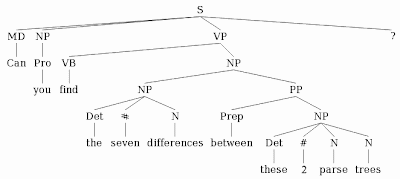

1. NP vs Np
2. # is rotated 90°
3. S vs Q at root
4. .—? vs ?
5. differences vs diferences
6. two vs 2
7. line length for MD—Can
Self-Defining Puzzle
by Swivelhips Smith, D.Phil.Taxidermy Tech
Scroll down for answers.
Keep going.
A little more.
1. NP vs Np
2. # is rotated 90°
3. S vs Q at root
4. .—? vs ?
5. differences vs diferences
6. two vs 2
7. line length for MD—Can
Monday, August 2, 2010
Polysemy Want a Cracker

As mentioned in a previous post about polysemy, the reference is to a single word with different senses of the same basic meaning. Polysemes are also distinguished from homonyms because they are etymologically related.
Following is a list of senses for the definition of the word "cracker" from the Oxford English Dictionary (see 8. a. and 9. a.):
One who or that which cracks (in any of the senses of the vb.).
1. gen.
2. esp. A boaster, braggart; hence, a liar.
3. familiar or colloq. A lie.
4. U.S. a. A contemptuous name given in southern States of N. America to the ‘poor whites’; whence, familiarly, to the native whites of Georgia and Florida. Also attrib. According to some, short for CORN CRACKER; but early quots. leave this doubtful.
b. attrib.; the Cracker State, Georgia.
5. A local name for the Pintail Duck (Dafila acuta), and the Corn-crake (Crex pratensis).
6. a. A kind of firework which explodes with a sharp report or a succession of sharp reports.
b. (In full cracker bon-bon.) A bon-bon, or small parcel of sweets, etc., containing a fulminant, which explodes when pulled sharply at both ends. attrib., as cracker-motto, -paper, -poetry, -rhyme.
c. An attachment to the end of a whip-lash by which a cracking sound can be produced. U.S., Austral. and N.Z.
7. A pistol. Obs. slang. (Cf. BARKER 4.)
8. a. An instrument for cracking or crushing something; a crusher; spec. in pl. nut-crackers.
b. humorously (in pl.). The teeth.
c. A cracking plant (see CRACK v. 23).
9. a. A thin hard biscuit. (Now chiefly in U.S.)
b. attrib. and Comb., as cracker-bag, -peddler; cracker-hash, a sailors' hash of biscuits and meat; so cracker-stew.
10. pl. (S. Africa). (See quot.)
11. slang. a. A ‘cracking’ or ‘rattling’ pace.
b. A break-down, a smash: cf. CRACK v. 15.
c. A pound(-note). Austral. and N.Z. slang.
Hence (nonce-wds.) cracker v. trans., to pelt with crackers. crackeress, a female cracker. crackery, crackers collectively.
1. gen.
2. esp. A boaster, braggart; hence, a liar.
3. familiar or colloq. A lie.
4. U.S. a. A contemptuous name given in southern States of N. America to the ‘poor whites’; whence, familiarly, to the native whites of Georgia and Florida. Also attrib. According to some, short for CORN CRACKER; but early quots. leave this doubtful.
b. attrib.; the Cracker State, Georgia.
5. A local name for the Pintail Duck (Dafila acuta), and the Corn-crake (Crex pratensis).
6. a. A kind of firework which explodes with a sharp report or a succession of sharp reports.
b. (In full cracker bon-bon.) A bon-bon, or small parcel of sweets, etc., containing a fulminant, which explodes when pulled sharply at both ends. attrib., as cracker-motto, -paper, -poetry, -rhyme.
c. An attachment to the end of a whip-lash by which a cracking sound can be produced. U.S., Austral. and N.Z.
7. A pistol. Obs. slang. (Cf. BARKER 4.)
8. a. An instrument for cracking or crushing something; a crusher; spec. in pl. nut-crackers.
b. humorously (in pl.). The teeth.
c. A cracking plant (see CRACK v. 23).
9. a. A thin hard biscuit. (Now chiefly in U.S.)
b. attrib. and Comb., as cracker-bag, -peddler; cracker-hash, a sailors' hash of biscuits and meat; so cracker-stew.
10. pl. (S. Africa). (See quot.)
11. slang. a. A ‘cracking’ or ‘rattling’ pace.
b. A break-down, a smash: cf. CRACK v. 15.
c. A pound(-note). Austral. and N.Z. slang.
Hence (nonce-wds.) cracker v. trans., to pelt with crackers. crackeress, a female cracker. crackery, crackers collectively.
Image from A Way with Words
Subscribe to:
Posts (Atom)
