Showing posts with label verbs. Show all posts

Thursday, October 27, 2011

You are Such an Idiomatic Luck-Out

I have been meaning to add my two cents to the topic of some posts about the phrasal verb "luck out" that have been making the rounds. The gist of the posts is the question of whether "lucking out" is a good thing or a bad thing.

Here is the background:
Language Log's "Lucking out"
Language Log's "More lucking out"
Superlinguo's "Lucking out"
TYWKIWDBI's "'Lucking out' can be good -- or bad."

The answer to my semantic interpretation of "luck out" can be found in my response to Superlinguo's post, which follows:

"Lucking out" was always a positive in my youth. Its use was so common in Michigan that many people turned the phrasal verb into a noun. "You got a pony for your birthday...you are such a luck-out."

Upon further analysis, I thought to compare "luck out" to some other idiomatic phrasal verbs that end in "out".

Here is what I came up with:
crap out
drop out
poop out
run out
stamp out
wipe out
wash out

For some reason, I could not think of one example that carries a positive semantic interpretation.

I wonder if that could be part of the reason that some people think of lucking out as a negative.

Wednesday, October 5, 2011

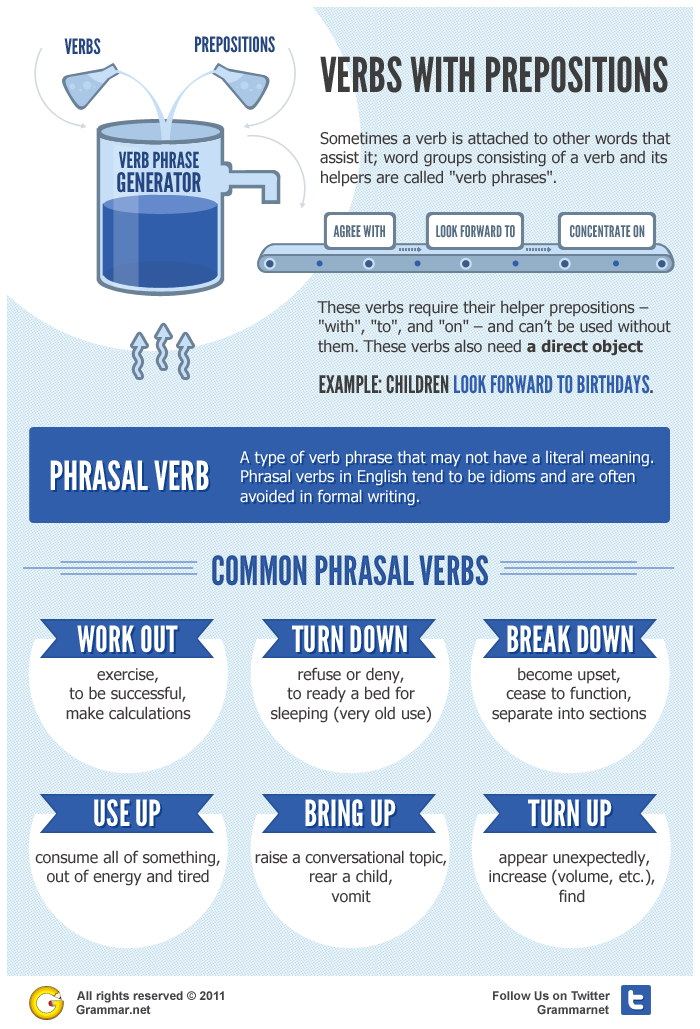
Verb Phrases and Phrasal Verbs


[Infographic provided by Grammar.net]

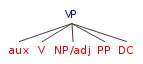
Taking this infographic a step further, here is the phrase structure rule for verb phrases in English.

VP = (aux)+ V + (NP)/(adj) + (PP) + (DC)

Items in parentheses are optional.

aux = auxiliary verb
V = verb
NP = noun phrase
adj = adjective
PP = prepositional phrase
DC = dependent clause


Click here to see additional phrase structure rules and phrase structure trees.

Wednesday, August 18, 2010

McDonald's Contradiction


There is a logical discrepency in the above sign.


Logically one can not park and drive-thru at the same time.

Wednesday, May 27, 2009

Adjective Noun Verbing Adverbially

I found this on StumbleUpon and I absolutely love it (but I would have used the word "adverbially").


A fun illustration and a great way to teach the parts of speech.

From ventrella.com

Tuesday, March 31, 2009

Language Peeves - "Went Missing"

A reader recently commented that it really bothers him when news headlines report a missing person by using the phrase "went missing" instead of "is missing."


In regards to this language peeve, the difference between "went missing" and "is missing" is a bit more involved than one might initially think...not only are the verbs in the phrases different, the verb type and tense are different as well. These verbal differences result in semantic differences, and the choice of using one phrase rather than the other may or may not be intentional.

Went is the past tense form of the verb to go. To go is an action verb.
Is is a present tense form of the verb to be. To be is a verb of being that is considered a linking verb.

Semantically, action verbs imply that choice is involved because people choose their actions, whereas linking verbs simply form an association between a subject and its complement. So, saying that a person "went missing" implies that that person chose to go missing and saying a person "is missing" implies that there was not a choice and that whatever happened was against that person's will. Additionally, because went is past tense, "went missing" leaves open the possibility that the person is no longer missing.

The choice of using one phrase rather than the other may be intentional if the possibility exists that the missing person is on the lam or it could just be that a copywriter was lazy and didn't give much thought to the semantics of the chosen verb.


Friday, May 16, 2008

4th Question of the Week Poll Results - Gerundizing

Well, I certainly didn't fool any of my readers with that question. Everyone answered verbalizing and everyone answered correctly. A gerund is a verbal noun; basically a noun derived from the -ing form of a verb. So to turn the verb verbalize into a noun you would add -ing to make verbalizing.

The official definition of a gerund as listed on Answers.com is:
1. In Latin, a noun derived from a verb and having all case forms except the nominative.
2. In other languages, a verbal noun analogous to the Latin gerund, such as the English form ending in -ing when used as a noun, as in singing in We admired the choir's singing.
Related Posts Plugin for WordPress, Blogger...