Monday, May 31, 2010

Props for a Vocabulary Update

Back in February of this year I posted about the word props and an observant reader, Joseph Christina RN, sent me the following which I thought I would share.

I was recently asked the origin of the phrase “giving props” to someone. The general attribution on the net is to rappers in the 80’s. Some further digging indicated that the phrase came into broader use after Aretha Franklin used the phrase in her cover of “Respect” in 1967. Although the song was written and released by Otis Redding in 1965, Aretha added the line:

“I'm about to give you all of my money - And all I'm askin' in return, honey - Is to give me my props”

Apparently, I’m not the first person trying to track this down. Below is an excerpt from The New York Times:

Bernard Schneider of Falmouth Foreside, Me., recalled that ''during a recently aired Ed Bradley interview of the artist on '60 Minutes,' he inferred that her artistic plea for propers was for adoration and attention of a sexual nature.''
That torrent of informed correction drove me to J. Redding Ware's 1909 ''Passing English of the Victorian Era,'' which touches lightly on the term as ''erotic.''
Reached during a tour that took her through Washington, Franklin is having none of that. Her use of propers (which many heard as profits ) in the lyric was her own, not in the words originally written and performed by Otis Redding in 1965.
''I do say propers ,'' says the queen of soul. ''I got it from the Detroit street. It was common street slang in the 1960's. The persons saying it has a sexual connotation couldn't be further from the truth. 'My propers ' means 'mutual respect' -- what you know is right.''


The original version of the article is available at http://www.nytimes.com/2002/07/28/magazine/28ONLANGUAGE.html
Aretha’s version of "Respect" was recorded on February 14, 1967, and we have her stating that it was “common street slang” in the Detroit area at that time.

Thank you for sharing Joseph; you deserve props. This was much more information than I came up with during my brief search. Also, I have lived in the Detroit area all of my life and have heard Aretha's version of the song more times than I can count so I am amazed that I never noticed the word before. I must have heard it as a mondegreen.

Friday, May 28, 2010

Linguistics Cartoon Favorites - Empty Bookshelf


For the love of technology.


P.S. I have searched high and low and can not remember where I got this cartoon, but it is too good not to share. If you created it or know the creator, please take credit.
P.P.S. Thanks to reader Ravantra - the artist is Frederick Deligne.

Wednesday, May 26, 2010

Nicknaming Hair Colors - Ginger

When I heard my son calling his friend "Ginger" the other day, I had to ask why. I was surprised to hear that it is a nickname for redheads (I was surprised because my mom is a redhead and in my 40 plus years I have never heard of redheads being called "Ginger"). When I probed further, I was told that it came from an episode of South Park with a group of redheaded children. Now it was starting to make sense to me. I had never heard the term because I do not watch South Park. But then I started to think more about the word "ginger" and about redheads, and I remembered Gilligan's Island. The character Ginger on Gilligan's Island was a redhead so maybe the redhead/ginger connection goes back further than I first thought.


According to the pertinent entries for the ginger in the Oxford English Dictionary (shown below) , the redhead/ginger connection dates as far back as 1785.


4. dial. and slang. a. A light sandy colour, resembling that of ginger.
1865 DICKENS Mut. Fr. I. ii, Mature young gentleman; with..too much ginger in his whiskers. 1889 N.W. Linc. Gloss. (ed. 2), Ginger, a light red or yellow colour, applied to the hair.


b. A cock with reddish plumage; also, a red-haired or sandy-haired person.
1785 GROSE Dict. Vulg. Tongue s.v. Ginger-pated, Red cocks are called gingers. 1797 Sporting Mag. IX. 338 In cocking, I suppose you will not find a better breed of gingers. 1857 H. AINSWORTH Spendthrift xvi. 109 Examining the cocks, and betting with each other..this backing a grey, that a ginger. 1885 in Eng. Illustr. Mag. June 605 There is..‘Ginger’, the red-haired, who [etc.].


But why ginger for a red-haired?...to me ginger is white.


I can't answer that question, but I did find the following dialogue on Explain the Ginger.


I started thinking that Turmeric root ( Curcuma rhizome) looks an awful lot like a ginger rhizome. However, turmeric is well known as a vegetable dye as well as a spice; it dyes a yellow to deep orange-red depending on the situation. So I poked around, and found this from the Penny Cyclopaedia of the Society for the Diffusion of Useful Knowledge(Great Britain, 1851)"C(urcuma) amada, Mango Ginger... is called mango because the fresh root has the smell of a mango. It is used for the same purposes as ginger."So although ginger itself is not particularly red or reddish, turmeric is redder, and makes a reddish orange dye. It seems that at some point in England it was sometimes called ginger.posted by oneirodynia at 5:37 PM on February 8, 2008


oneirodynia, actually Curcuma amada (mango ginger) is different from turmeric (Curcuma longa. It's a variant of ginger with a distinct mango-like taste. It's actually very tasty made into a pickle. It's quite common in India.posted by peacheater at 7:03 PM on February 8, 2008


Yes, but the point is that Curcumins look like ginger, and most if not all have orange/red dying properties, and some of them were known in England as "ginger" in spite of not necessarily being what we call ginger today. Curcuma are in the Zingerberaceae family. I'm not trying to say tumeric and mango ginger are the same thing.posted by oneirodynia at 7:52 PM on February 8, 2008


On the other hand, maybe the term ginger is used to refer to a redheads because the flower of the ginger plant is red.


P.S. Apparently in Australia the nickname for a redhead is "bluey" because of the Australians' appreciation of irony. Though I did read somewhere (I can not remember for the life of me where), that it could also have to do with vegetable colors, specifically the Australian blue squash which has teal-gray skin encasing bright orange flesh.

Monday, May 24, 2010

Noam Chomsky in the News

"The government of Israel does not like the kinds of things I say, which puts them into the category of, I suppose, every other government in the world."


- Noam Chomsky in response to being blocked by Israeli border guards from entering the West Bank through Jordan, quoted in The Week (May 28, 2010 issue)


I wonder if they would have let this Noam cross the border?


*Spotted on JustSay Gnome!

Noam Chomsky is considered to be one of the fathers of modern linguistics. Click here to read more about Chomsky.

Are You Envoweled?

According to the website is this your name?, I am extremely well envoweled (at least my name is, anyhow).

50% of the letters that make up my name are vowels and of one million first and last names reviewed by the site, only 2.2% have a higher vowel make-up.

I am thrilled that I can do my share to support the use of vowels, after all, without vowels (vowel sounds, that is) there would be no syllables and thus no rhymes; language would lose its poetic nature.

*The vowel sound is the nucleus of the rhyme and the only mandatory element of a syllable.

* A vowel letter does not always equal a vowel sound (ex. the word "tote" is written with two vowels but when transcribed phonetically, /tot/, it only has one vowel sound).

Wednesday, May 19, 2010

Inspiring Ideas with Symbols - Semiotic Priming

The connection between the image of a light bulb and the inception of a winning idea is so strong that nine of the first ten images returned when performing a google image search for the word "idea" include light bulbs.


So what do light bulbs and ideas have to do with linguistics, you might ask.


Well, if a light bulb is viewed semiotically as a symbol that people use to communicate the concept of "idea", this symbol can be considered a part of our language.


The reason I bring this up is that the May 21st issue of The Week magazine included a report from LiveScience.com, which concludes that "just showing a real light bulb to people can actually trigger insights."


The article further reports that "psychologists at Tufts University gave volunteers a series of puzzles to solve under time pressure. Part way through the test, either a bare light bulb or an overhead fluorescent light was turned on in the room. The researchers found that volunteers exposed to the light bulb were 50 percent to 70 percent more successful at the puzzles than subjects given the fluorescent light."


WOW.


In other words, the image of a light bulb can be used to semiotically prime (stimulate) people to come up with ideas that solve puzzles.

Tuesday, May 18, 2010

Name That Genre with People Magazine

When People magazine reviews a movie, the review usually starts out with an information box that lists the genre of the movie. The following picture is an example from the May 24th issue review of Robin Hood.


The same issue also includes a review of the movie Letters to Juliet.


Here is a closer look at the information box from this review.


Unless there is a new movie genre named, simply, "genre" I have to believe the article writer/editor forgot to fill in the genre in the layout for this review.


Monday, May 17, 2010

Wordplay for Phoneticians

Following is a rebus-like variation of a well-known idiom. Can you guess what it is?

ull ou all the sos.


Here is a pictographic hint.


And the answer is:


Pull out all the stops.


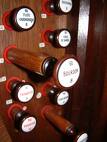
In phonetics, a stop is a sound that is made by completely stopping and then releasing airflow in the vocal tract. The first version of the idiom in this post is written without the alphabetic letters that represent the stop sounds.

These are the sounds that the IPA classifies as stops: /p,b,t,d,k,g/.

The idiom "pull out all the stops" is defined by thefreedictionary.com as:
"to do everything you can to make something successful."


The Phrase Finder notes on the origin of the phrase include:

"The popular belief is that this phrase derives from the manner of construction of pipe organs. These instruments have stops to control the air flow through the pipes and pulling them out increases the musical volume. This seems to be the type of casual easy answer that is the hallmark of folk etymology. In this case, the popular belief isn't a fallacy but is in fact correct."

Etymologically, this idiom has more to do with phonetics than the uninitiated might picture at first glance.


Friday, May 14, 2010

The Semantics of Slower Traffic - Part 2

In The Semantics of Slower Traffic, I posted about a semantically-challenged sub-set of automobile drivers who have a problem defining the word "slower" - particularly when it comes to the following sign.

I just received an e-mail with this brilliant photo-shopped picture that leaves no room for doubt about which drivers should be in which lanes on an expressway. - Thank you Bro


And here is one more picture to help reinforce the concept.

Wednesday, May 12, 2010

Unilingualism and Bilingualism in the U.S. and Canada


The May 14th issue of The Week magazine contains a column from Mclean's by Canadian writer and political commentator, Mark Steyn in which he claims that Canada discriminates against the unilingual in a way that the Human Rights Commission would never tolerate if this discrimination were against a "black or gay or Muslim." Canada has two official languages, French and English and Steyn states that, "every job that matters" is reserved for someone who can speak both French and English-- from the governor-generalship "down to the village postmistress." Steyn urges Canada to, "fight unilinguaphobia."


While I don't follow Canadian politics enough to know if this is true or not, I bring it up because I found it interesting based upon what was on the very next page of the same magazine.


Under the heading "Talking Points", the following was excerpted from the Chicago Tribune: "The number of U.S. residents who speak a language other than English at home more than doubled over the past 30 years, to 55 million, the U.S. Census Bureau reported. That's 20 percent of the population."


Interesting juxtaposition, language-wise with the neighboring countries and page-wise with the information in the magazine.

Monday, May 10, 2010

WTF ROTFL LOL - JK

WTF does ROTFL mean? I am truly not a prescriptivist, but I am still not LOL.


This past December, Language - The Journal of the Linguistic Society of America published a review of The gr8 db8 by David Crystal. I have not read the book but I have been meaning to mention my initial thoughts about the frequency of initialisms in texting.

The thing that annoys me most about the initialisms associated with texting is that the majority of the most common initialisms are not abbreviations for phrases that anyone I know actually used before the invention of instant messaging.

On the other hand, when I was coming of age and we sent messages that were not so instant ("Hey, please pass this note to so and so.") the only abbreviation/initialism that I recall using with any frequency was "JK" and we used the phrase "just kidding" in normal conversation on a regular basis.

Just sayin. (See, I am really not a prescriptivist)

Friday, May 7, 2010

Playing with Spelling, Sounds and Semantics - Linguistics Humor Part II

1. A bicycle can't stand alone; it is two tired.
2. A will is a dead giveaway.
3. When a clock is hungry it goes back four seconds.
4. The guy who fell onto an upholstery machine was fully recovered.
5. You are stuck with your debt if you can't budge it.
6. He broke into song because he couldn't find the key.
7. A calendar's days are numbered.
8. A boiled egg is hard to beat.
9. He had a photographic memory which was never developed.
10. Those who get too big for their britches will be exposed in the end.
11. When you've seen one shopping center you've seen a mall.
12. If you jump off a Paris bridge, you are in Seine.
13. When she saw her first strands of gray hair, she thought she'd dye.
14. Acupuncture: a jab well done.
15. Marathon runners with bad shoes suffer the agony of de feet.
16. Tonto’s banker…the Loan Arranger.
17. If a skunk went to church, would it sit in its own pew?

- From an e-mail, author/s unknown


For more linguistics humor check out:
Playing with Spelling, Sounds and Semantics - Linguistics Humor Part I

Wednesday, May 5, 2010

Language Specific Shopping Acronyms

I am not much of a shopper, but as I passsed a store advertising a sale today it struck me how much the acronym for "BUY ONE, GET ONE" has truly become a standard part of the lingo of shopping in the United States. As I read the sign (similar to the one pictured below)...


I immediately read aloud to myself, "bogo" (phonetically, /bogo/). By the way, it is not uncommon to overhear people discussing which store is currently having a bogo. In fact, it has become so common that some stores advertise as follows:


This, of course, got my language-loving brain thinking about other languages and their shopping acronyms.

If English language speakers have "BOGO"...are the following acronyms used by native language speakers in their respective countries?

AUOU (acheter un obtenir un) in France

CUyLU (compre uno y llévese uno) in Spain

KSEAM (Kaufen Sie eine ankommen man) in Germany

OYSY (ostaa yhden saat yhden ) in Finland

VEKE (vesz egy kap egy) in Hungary

KEFE (Kaupa einn fá einn) in Iceland

CACCAF (ceann a cheannach ceann a fháil) in Ireland

PUPD (paghi uno prendi due) in Italy

Monday, May 3, 2010

Who Had the Fork? - Sentence Ambiguity Diagrammed

The cat ate the mouse with a fork.

IS IT...
The cat used a fork to eat the mouse. (The cat had the fork)

OR IS IT...
The cat ate the mouse that had a fork in its possesion. (The mouse had the fork)


Click here for more sentence ambiguity diagrams.


Related Posts Plugin for WordPress, Blogger...