Monday, October 31, 2011

Stop in the Name of Halloween

Have a /fæntæstɪk/ holiday.

Thanks for carving and sharing the this awesome pumpkin, lesserjoke.

Thursday, October 27, 2011

You are Such an Idiomatic Luck-Out

I have been meaning to add my two cents to the topic of some posts about the phrasal verb "luck out" that have been making the rounds. The gist of the posts is the question of whether "lucking out" is a good thing or a bad thing.

Here is the background:
Language Log's "Lucking out"
Language Log's "More lucking out"
Superlinguo's "Lucking out"
TYWKIWDBI's "'Lucking out' can be good -- or bad."

The answer to my semantic interpretation of "luck out" can be found in my response to Superlinguo's post, which follows:

"Lucking out" was always a positive in my youth. Its use was so common in Michigan that many people turned the phrasal verb into a noun. "You got a pony for your birthday...you are such a luck-out."

Upon further analysis, I thought to compare "luck out" to some other idiomatic phrasal verbs that end in "out".

Here is what I came up with:
crap out
drop out
poop out
run out
stamp out
wipe out
wash out

For some reason, I could not think of one example that carries a positive semantic interpretation.

I wonder if that could be part of the reason that some people think of lucking out as a negative.

Monday, October 24, 2011

Random Linguistics Definitions Beginning with the Letter "F"

F = Waw (Semitic)
Waw = Hook

false friends In comparative linguistics, a term describing words in different languages which resemble each other in form, but which express different meanings; also called false cognates, and often known by the French equivalent expression faux amis. Examples include French demander, which translates into English as 'to request' not 'to demant', and Italian caldo which translates as 'warm' not 'cold'.

forensic linguistics In linguistics, the use of linguistic techniques to investigate crimes in which language data forms part of the evidence, such as in the use of grammatical or lexical criteria to authenticate police statements. The field of forensic phonetics is often distinguished as a separate domain, dealing with such matters as speaker identification, voice line-ups, speaker profiling, tape enhancement, tape authentication, and the decoding of disputed utterance.

fortition A term used in phonology to refer to a strengthening in the overall force of a sound, whether diachronically or synchronically; opposed to lentition. Typically, fortition involves the change from a fricative to a stop, an approximant to a fricative, or a voiced to a voiceless sound (as in the devoicing of final obstruents in German).

Definitions from: A Dictionary of Linguistics and Phonetics, Sixth edition, 2008
Image credits: Panel of Thoughts

Friday, October 21, 2011

How Do You Pronounce That?

A channel on You Tube called Pronunciation Book gives audio demonstrations of the pronunciation of various words. I don't know how they choose the words, but there are plenty of random and entertaining words from which to choose.

Wednesday, October 19, 2011

Dialect and Accent Archive Links

I was recently asked for recommendations on resources for audio speech links.

Here are a few of my favorites:

The Speech Accent Archive


The above dialect map of the United States is from Dialects of English. The link also has information about British English, Australian English and more.

Additionally, here is a link to a Modern Language Association Language Map.

Monday, October 17, 2011

Random Linguistics Definitions Beginning with the Letter "E"

E = Protosinaitic Script
Script = Jubilation


enantiosemy A case of polysemy in which one sense is in some respect the opposite of another. E.g. that of dust in I dusted the mantelpiece, meaning that something is removed, vs. I dusted the cake with sugar, meaning that something is added.

ethnolect Variety of a language spoken by a so-called 'ethnic group'.

eventive Referring to an event as opposed to a state: e.g. fell is eventive in I fell over. Opp. stative.

Definitions from: The Concise Oxford Dictionary of Linguistics, Second edition, 2007
Image credits: Panel of Thoughts

Saturday, October 15, 2011

Two Days Remaining - Vote to Determine Grammar.net’s Best Grammar Blog of 2011


Please don't forget to cast your vote here for A Walk in the Words.

Thank you, dear readers.

Word Enthusiasm

I was browsing on TED the other day and came across this outstanding talk by lexicographer Erin McKean. It is entrancingly entertaining and educational. Enjoy.

The Language of "X"


Fritinancy brought Lexicon Blog's post Understanding The “X” Factor to my attention through her October Linkfest.

It is a an informative and interesting post; however, I am surprised that a post written by Dr. Will Leben, Lexicon Director of Linguistics, neglected to mention that the letter "X" is used to signify an arbitrary lexical category in Chomsky's X-Bar Theory.

Image credits.

Friday, October 14, 2011

I Definitely Like Dictionaries Better Than the Internet


These images are from a Happy Place post titled "How to keep the grammatically challenged off the Internet." The link above has more images.

I think the post does a good job of pointing out many common spelling and grammatical errors; however, a couple of items from the post caught my attention.

The title of the post does not have proper capitalization. It should be "How to Keep the Grammatically-Challenged Off the Internet." See here.

Additionally, I find it interesting that whoever created the images chose to capitalize The Internet almost as if it is comparable to The Bible.

###

Update: The adjective "grammatically-challenged" could be hyphenated because the two words serve as a single adjective that modifies a noun (albeit an implied noun, grammatically-challenged people); however the more relied upon style guides do not require/recommend this.


Monday, October 10, 2011

Random Linguistics Definitions Beginning with the Letter "D"

D = Dalet
Dalet = Egyptian Hieroglyph
Hieroglyph = Door

deverbal A term used in grammar to describe an element which originates as a verb but is used in some other way in sentence structure. For example, in the singing policeman, singing could be described as a deverbal adjective; in I made a go of it, go is a deverbal noun.

ditransitive A term used by some linguists to describe a verb which can take two objects, e.g. give (I gave him a book). It is usually distinguished from 'monotransitive' verbs, such as kick.

Definitions from: A Dictionary of Linguistics and Phonetics, Sixth edition, 2008
Image credits: Panel of Thoughts

Saturday, October 8, 2011

The Many Languages of Mourning Steve Jobs

From Wired.com:

"In the hours after Steve Jobs’ passing, researchers at the New England Complex Systems Institute tried to track the spread of memorial tweets spreading through the internet. Their computers were overwhelmed.

Rather than focusing on network dynamics, they decided to analyze the tributes by language. Jobs wasn’t just an American visionary, but truly global.

Above is a breakdown of two million tweets containing the name “Steve Jobs” and posted between 9 pm on Oct. 5 and 9 am the next morning. Each dot represents 1,000 tweets, and they’re colored according to language. A high-resolution version containing the most-retweeted messages can be downloaded here."


Wednesday, October 5, 2011

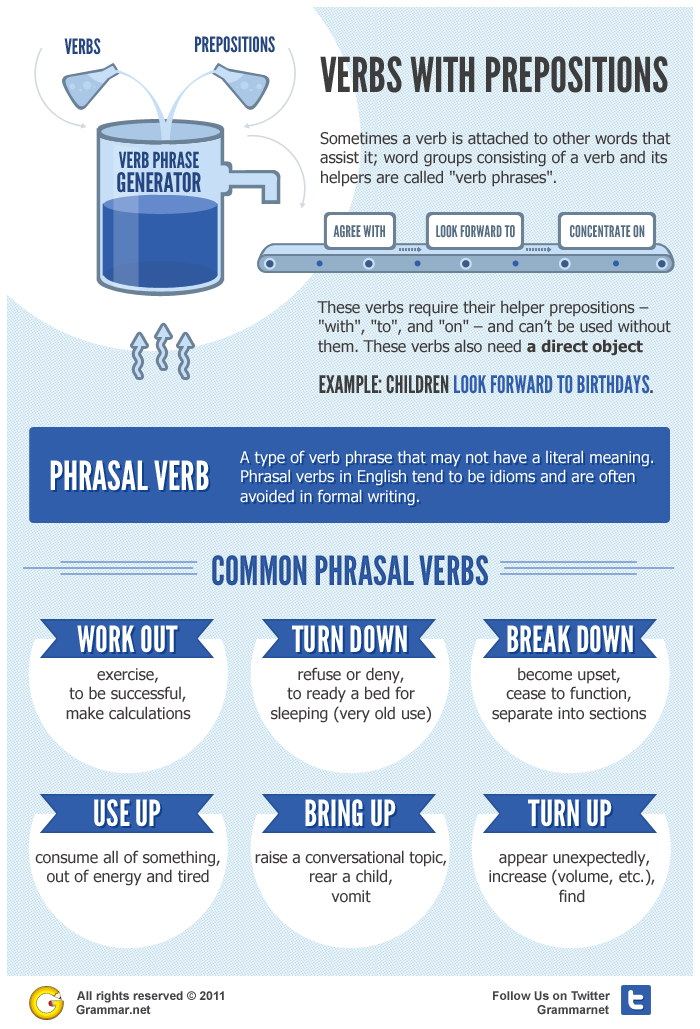
Verb Phrases and Phrasal Verbs


[Infographic provided by Grammar.net]

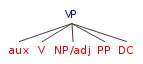
Taking this infographic a step further, here is the phrase structure rule for verb phrases in English.

VP = (aux)+ V + (NP)/(adj) + (PP) + (DC)

Items in parentheses are optional.

aux = auxiliary verb
V = verb
NP = noun phrase
adj = adjective
PP = prepositional phrase
DC = dependent clause


Click here to see additional phrase structure rules and phrase structure trees.

Monday, October 3, 2011

Random Linguistics Definitions Beginning with the Letter "C"

C = Egyptian Hieroglyph
Hieroglyph = Throwing Stick

calque A word or expression which has been formed by translation of a corresponding word or expression in another language. E.g. French gratte-ciel 'sky scraper' (lit. 'scratch-sky') is a calque on English skyscraper. Also called a loan translation.

closed class A class of words or morphemes whose membership is fixed and can be listed. E.g. there is a closed class of determiners (the, this, etc.). Opp. open class.

'cranberry morpheme' One like cran- in cranberry, which is found in one combination only.

Definitions from: The Concise Oxford Dictionary of Linguistics, Second edition, 2007
Image credits: Panel of Thoughts
Related Posts Plugin for WordPress, Blogger...