Showing posts sorted by relevance for query ambiguity. Sort by date Show all posts

Monday, June 22, 2009

Would That Be an Example of Ambiguity or Vagueness?

The answer is both when talking about the word "triangle."
The word "triangle" is ambiguous when it is unclear on whether it is denoting the shape, the musical instrument or the drafting tool. The word "triangle" is vague when it is referencing the shape because it is indefinite about whether it denotes a scalene, isosceles, obtuse, right, acute or equilateral triangle.


Ambiguous words have more than one meaning, for example: the word "light" meaning "not heavy" and the word "light" meaning "not dark."

Vague words have more than one sense of the same meaning, for example: the word "child" is defined as "a young person" and that young person could be either male or female.

A test to help determine a word's ambiguity status is whether or not the word has two unrelated antonyms, for example: the word "hard" is ambiguous because it has the antonyms "soft" and "easy."

Friday, July 18, 2008

Crossword Puzzle Clues and Semantics

I have always been a huge fan of crossword puzzles and, in a round-about way, my love of crossword puzzles was partly responsible for my decision to study linguistics in graduate school. So naturally, I tend to semantically analyze crossword puzzle clues while working a puzzle. As a result, I believe that the relationship between crossword puzzles and semantics should be seen as reciprocal because working a puzzle not only calls on semantic knowledge, it also reinforces and adds to a person's semantic knowledge, whether consciously or not.

The role semantic knowledge plays in solving a crossword should become clear by looking at some of the common crossword puzzle clue categories and the semantic concepts with which they can be compared.

Traditional dictionary definitions = reference
Thesaurus = synonymy
Encyclopedic = reference
Names = reference
Opposites = antonymy
Puns and wordplay = vagueness and ambiguity, polysemy
“A kind of” = hyponymy
Indirect = vagueness and ambiguity

Wednesday, July 21, 2010

Syntax with Sherlock - Sentence Ambiguity Illustrated and Diagrammed

*For simplicity's sake, because the phrase "using binoculars" functions like a prepositional phrase, I have taken the liberty of changing "using" to "with" for the diagrams.


Here is a syntactic diagram of the version of the sentence pictured on the left.


Here is a syntactic diagram of the version of the sentence pictured on the right.


The above syntactic trees show that the ambiguous nature of the sentence results from the possibility of the prepositional phrase attaching to the noun phrase or directly to the verb phrase.


Click here for more sentence ambiguity diagrams.


Sherlock image from - http://bb.ustc.edu.cn/


Monday, May 3, 2010

Who Had the Fork? - Sentence Ambiguity Diagrammed

The cat ate the mouse with a fork.

IS IT...
The cat used a fork to eat the mouse. (The cat had the fork)

OR IS IT...
The cat ate the mouse that had a fork in its possesion. (The mouse had the fork)


Click here for more sentence ambiguity diagrams.


Monday, March 1, 2010

Ambiguity Generators

I passed a van the other day with a custom paint job that advertised the name of a company - Budget Generators. My first thought upon seeing the van was that I would love to have someone generate a budget so my family could take a trip to a tropical island for spring break this year (This is the way my wordplay-loving, sarcastic mind operates).

Unfortunately, that is not the company's line of work.

Here is the information I found when I googled the name of the company:


Merchant Information
Generator Systems, Home, Installation, Natural Gas, Whole
Main Website,
Hours: 24/7
Payment: cash/check


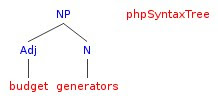
The name of the company can be interpreted as (1) a noun phrase made up of an adjective plus a noun, or (2) a noun phrase consisting of a noun plus noun compound word.
(1)
(2)
It is the multiple meanings of the words "budget" and "generator" that lead to this ambiguity. From the thefreedictionary.com:

generator - a machine that converts mechanical energy into electricity to serve as a power source for other machines.
or
generator - someone who originates or causes or initiates something; "he was the generator of several complaints".

budget n. - allowance, means, funds, income, finances, resources, allocation
or
budget adj. - inexpensive, economy, bargain, sale, reduced, keen, reasonable, low-priced, low-cost, cut-price, economical, cheapo
What kind of budget generator would you prefer?

Wednesday, February 17, 2010

Nose Ring Ambiguity Diagrammed


What better way to have fun with an intentionally ambiguous cartoon than to diagram the ambiguous sentence in the cartoon!


Gotta love the humor that ambiguity provides.

Friday, December 16, 2011

Book Review Briefs: Understanding Language Through Humor

"Understanding Language Through Humor" by Stanley Dubinsky and Chris Holcomb
ʌ ʌ (2 carets up)

This is the perfect book for anyone who wants to learn more about the inner workings of language while being entertained at the same time. I would recommend it for high school age readers and up. The book is capable of being purely a pleasure read (an educational pleasure as an added bonus) as well as a study companion for students in language-themed courses. I will certainly use this book as a resource the next time I teach an introductory linguistics class.

Here is a summary from Cambridge University Press:

Students often struggle to understand linguistic concepts through examples of language data provided in class or in texts. Presented with ambiguous information, students frequently respond that they don't 'get it'. The solution is to find an example of humour that relies on the targeted ambiguity. Once they laugh at the joke, they have tacitly understood the concept, and then it is only a matter of explaining why they found it funny. Utilizing cartoons and jokes illustrating linguistic concepts, this book makes it easy to understand these concepts, while keeping the reader's attention and interest. Organized like a course textbook in linguistics, it covers all the major topics in a typical linguistics survey course, including communication systems, phonetics and phonology, morphemes, words, phrases, sentences, language use, discourses, child language acquisition and language variation, while avoiding technical terminology.

Here is a joke from the book that is used to illustrate deictic confusion:

A guy phones the local hospital and yells, "You've gotta help! My wife is in labor!" The nurse says, "Calm down. Is this her first child?" He replies, "No! This is her husband!"

And here is the table of contents:

1. Introduction
2. Talking to Garfield: human and animal communication
3. Did I hear that right? The sounds of language
4. Twisted words: word structure and meaning
5. Fitting words together: phrase structure and meaning
6. Meaning one thing and saying another: indirect speech and conversational principles
7. Fitting the pieces together: the structure of discourse
8. 'Kids say the darndest things': children acquiring language
9. Variety is the spice of life: language variation
10. Cross-cultural gaffes: language and culture
11. The language police: prescriptivism and standardization
12. So long, and thanks for all the fish.

Don't let the portion of the book description that says it avoids "technical terminology" lead you to believe the book is simplistic; it is not. I think it would have been more accurate to say "overly technical terminology". The book is smart and accessible at the same time.

Thursday, February 12, 2009

Grice's Conversational Maxims

In the study of pragmatics it is well known that the success of any communication is dependant upon the cooperation of both the speaker and the listener. Paul Grice was a linguist and philosopher who made many contributions in this area of pragmatics. He suggested that there is, what he called, a cooperative principle that dictates how people behave and interact with each other during a conversation. Included as part of this cooperative principle are what are known as Grice's Conversation Maxims.

Maxim of Quantity:
-Make your contribution to the conversation as informative as necessary.
-Do not make your contribution to the conversation more informative than necessary.

Maxim of Quality:
-Do not say what you believe to be false.
-Do not say that for which you lack adequate evidence.

Maxim of Relevance:
-Be relevant (i.e., say things related to the current topic of the conversation).

Maxim of Manner:
-Avoid obscurity of expression.
-Avoid ambiguity.
-Be brief (avoid unnecessary wordiness).
-Be orderly.

If only every speaker would remember to cooperate. I know quite a few people that don't seem to follow these maxims, especially the Maxims of Quantity and Relevance.

P.S. In pragmatics writer and reader are equivalent to speaker and listener.

Wednesday, December 16, 2009

Where Was the Girl? - Sentence Ambiguity Diagrammed

Harry ordered a drink for the girl at the bar.


The girl at the bar is the one Harry ordered the drink for.


Harry ordered a drink, at the bar, for the girl (the girl sitting at a table? the girl in the bathroom? the girl across the street?).
Syntax really can be fun.

Tuesday, August 16, 2011

From Noun to Verb and Back Again


napkin

n.
a small piece of table linen that is used to wipe the mouth and to cover the lap in order to protect clothing.
v. to wipe the mouth with a small piece of table linen.
napkining n. (gerund)

Additional linguistic observations
Ad 2 (lower left): Playing with ambiguity - triangle as shape or musical instrument.
Ad 3 (lower right): Potential portmanteau - equal + equilateral.
Related Posts Plugin for WordPress, Blogger...