Wednesday, March 31, 2010

T33 Tim3 for Golfers

Semiotics for golfers:


Seeing this cover made me wonder if the editors of Michigan Links got a bit of inspiration from the television show Numbers?


Monday, March 29, 2010

Moist Cellar Doors

There is a linguistic phenomenon referred to as "word aversion" in which there are certain words in the English language that when read or heard provoke a tremendously negative reaction for people. Quite frequently, when the subject of word aversion comes up, the first word that comes to many a person's mind is "moist". Language Log has written about this topic numerous times and there is even a Facebook group called I HATE the word MOIST! whose description is "If the very word "moist" makes you cringe every time you hear it, this group is for you."


The reason I bring up this subject today is that I noticed something while taking a shower this morning. I am so accustomed to seeing the purple shampoo and conditioner bottles that I normally don't pay much attention to them; but for some reason I noticed the product name today - Aussie Moist. I guess Proctor and Gamble has not heard of "word aversion". I guess also, that I am not averse to the word "moist" because I purchased the product.


On the flip side of this phenomenon is a belief held by certain individuals that some words and phrases are more beautiful than others. In linguistics the study of the harmoniousness of words and phrases is called phonaesthetics and the most frequently mentioned example of a phonoaesthetically-pleasing phrase is "cellar door". In fact, a character in the movie Donnie Darko even referenced the loveliness of the words giving credit to a "famous linguist" for the idea. Though the writer/linguist J.R.R. Tolkien is often given this credit, Grant Barrett's On Language column in The New York Times, points out that the aesthetic properties of cellar door were mentioned as early as 1903 by Shakespeare scholar Cyrus Lauron Hooper in a book titled Gee-Boy.


Long story short, phonoaesthetically speaking cellar door could be considered the opposite of moist so I wonder what happens to people when they hear or read the phrase moist cellar door?


Saturday, March 27, 2010

More Celebrity Anagrams

Celebrity anagrams can be even more entertaining than the actual celebrities are. Here are some good ones from an e-mail I received recently.


John Mayer - Enjoy Harm
Sandra Bullock - Skull and Cobra
Arnold Schwarzenegger - He's Grown Large 'n' Crazed
Beyonce Knowles - Woken Obscenely
Justin Timberlake - I'm a Jerk, But Listen
James Cameron - Major Menaces
Robin Williams - I Warm Billions
Mel Gibson - Big Melons
Clint Eastwood - Old West Action
Jerry Seinfeld - Friendly Jeers
Conan O'Brien - Inane Bronco
Howard Stern - Wonder Trash
Woody Allen - A Lewd Loony
Jennifer Aniston - Fine in Torn Jeans
Sylvester Stallone - Slovenly Steel Star
George Clooney - Cool Energy, Ego
David Letterman - Nerd Amid Late TV
Leonard Nimoy - I'm Only a Drone

Friday, March 26, 2010

Homonyms, Innuendo and Obama's Package

Though the original article is over a year old, this photo of a headline from Eastern Michigan University's The Echo just showed up in my e-mail this week.


At first glance, I assumed it was another poorly written headline similar to a crash blossom. I figured the article was probably about Obama's economic stimulus package and not about the type of package that Urban Dictionary defines as "Male genitalia (penis and scrotum together), often associated with large size." I had a good chuckle at how homonyms lend themselves to humorous interpretations of vague sentences (quite the innuendo in this case).


Then I decided to look for the original article.


I have never seen such an outstanding example of having fun with language. Not only is the headline an example of intentional wordplay, the entire article is a wonderful satirical innuendo. Great job Tom Brandt.

Here is the article in its entirety:


Republicans are not sparing the rod when it comes to beating up on President Obama’s economic stimulus package, but it’s clear they are unable to raise their membership to withstand the newly found vigor of his congressional muscle.

President Obama’s massive $819 billion spending-and-tax-cut package was rammed through the U.S. House of Representatives on Wednesday without the support of a single Republican member. Even with 11 Democratic representatives opposing the bill, the 244-to-188 count reflected the bulging Democratic majority that has now swollen the House.

Ever since the Republican fantasy of endless majorities began collapsing beneath a disgusting load of GOP lies and incompetence in 2006, Republicans have quickly come to realize they can look probably forward to many legislative defeats like Wednesday’s ahead.

For six long years, America gave the Republicans all the rope they wanted – and sure enough – now they have hung themselves.

While the lopsided tally of Wednesday’s House vote surely must have been hard on GOP members, President Obama was not about to stick it to Republicans, as he graciously invited Congressional leaders of both parties to the White House that evening for cocktails.

“He said he wanted action, bold and swift,” pointed out Speaker Nancy Pelosi, Democrat of California, according to the New York Times, as debate began Wednesday morning on Obama’s gigantic package, “and that is exactly what we we’re doing today.”

As debate over the dimensions of Obama’s package snaked through the House, the blame game over who bore responsibility for America’s current economic pickle grew predictably partisan.

According to the Times account, Rep. Virginia Foxx, Republican of North Carolina, raised the familiar argument that GOP tax cuts in 2001 had stimulated years of job growth. The firmness of the U.S. economy had only flagged, Rep. Foxx complained, once Democrats fastened their grip on Congress in 2006.

These comments obviously pricked the ears of Democratic Rep. Steny Hoyer of Maryland, who noodled his GOP opponents by pointing out it was their member’s dysfunction that savaged America with “the economics that got us into this mess.”

Although conservative commentators like Fox News’s Glenn Beck have hammered the president’s stimulus package as somehow “socialistic,” arguing in his January 26th column that America should “call a spade a spade,” most observers view the Obama plan as much more likely to stimulate America’s flaccid free-market system than Bush and Paulson’s bailouts for the big banks – which shafted the country’s real working stiffs.

The meat of the Obama package consists of billions for the states, and programs to help families overcome the hardships brought on by six years of Republicans jimmying with government regulation and jacking up corporate welfare.

In the end, witnessing the Obama stimulus package being massaged by Congress is much like watching any government sausage being made; it’s not for the faint of heart. But this package is probably the best tool available to stimulate America’s soft economy – and in that, we can all take some satisfaction.

The Obama package may not be the best piece of stimulative legislation ever to enter the Oval Office, but it represents the best job harried congressional members are likely to come up with. And it certainly beats any package Bush ever raised.

Wednesday, March 24, 2010

Mmm Mmm Ambiguous Advertising (includes vagueness and a spelling error )

This is a screen shot from the website of one of my family's favorite pizza places.


Is the advertised special a [[large family] [deal]] ?
Or a [[large][family deal]] ?
If the advertised special is for a [[large family] [deal]] as the ad layout suggests, is it for a family that is large in number or a family whose members are large in size?

I'm pretty sure the advertisers meant the advertised special to be interpreted as a [[large][family deal]] because the special includes a large pizza and a large salad, but the word choice and the way the words are arranged on the two different lines make the deal both ambiguous and vague at the same time.

Also, no matter how "mmm, mmm good" their pizza is, I still don't like the extra "m" in the box about on-line ordering.

Monday, March 22, 2010

Word Play - License Plate Semiotics

License Plate Quiz


Custom license plates (sometimes called vanity plates) often make use of a combination of letters and numbers to convey a message semiotically.


What do you think this license plate says?


Please click on the comment button to submit your answer.


For more fun with license plates, be sure to check out Vanity Plates: Creepiness in 8 Characters or Less.

Wednesday, March 17, 2010

Fun with Phrases - Mixing Minced Oaths

During my youth, both "Geez Louise" and "For Pete's sake" were commonly used minced oaths in my family.

Here is my spin on the two:

Geez Louise + For Pete's sake


= For Louise's sake


Monday, March 15, 2010

Make No Exception for Incorrect Spelling

I could comment about the odd mixture of upper and lower case letters on this sign, or about the overuse of exclamation points, but what really jumps out at me is the incorrect spelling of the word "exception".


PLeAse WAit here for Snow Bus Shuttle
thanks!!
NO DOGS!!
No EcepTions!!

(except for my dog, of course)

Friday, March 12, 2010

Linguistics Quotation Favorites - Words

"The trouble with words is that you never know whose mouth they've been in."


-Dennis Potter

British Dramatist

Thursday, March 11, 2010

Crash Blossoms, Bears, and Drinking Rockets

After reading yesterday's post about crash blossoms, reader JCR shared a link to this picture from photographer Larry Blackwood.


"I sat next to this dumpster for the longest time, never saw a single bear exit, or enter for that matter." - Larry Blackwood

And speaking of crash blossoms, here is my new favorite as posted by Language Log last week:

"Number of Lothian patients made ill by drinking rockets"

It really is hard to think of "rockets" as the main verb when parsing this sentence. And while the thought of a person chugging a glass full of rockets doesn't quite sit right, it sure is humorous.

Wednesday, March 10, 2010

Blossoms Crash on Garden Path Resulting in Conflicting Trees

Garden path sentences are those that lead a reader down a path to an incorrect semantic and/or syntactic interpretation of the sentence during the initial analysis or parsing of the sentence. The field of psycholinguistics has shown that these incorrect interpretations occur because readers process sentences one word at a time.


A simple yet cogent example of a garden path sentence is:

The old man the boat.

When reading this sentence the most likely initial interpretation (illustrated by the syntactic tree below) is that "old" is an adjective describing "man". But what happens when you get to "the boat"? This can't be a sentence without a verb.
By backtracking and reading the sentence again the proper interpretation with "old" being a collective noun and "man" being a verb can be reached. In other words, "the boat is manned by the old (people)."
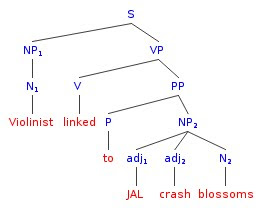
Similar to garden path sentences are newspaper headlines that are written in such a way as to lead a reader to an incorrect interpretation (often by omission of words). These headlines have been dubbed "crash blossoms" based on the following headline:


Here is a diagram of the likely initial interpretation followed by a diagram of the intended interpretation (with words added for clarification).


Parse 1:

Parse 2:Language Log posted more about the evolution of the name "crash blossoms" here.

And here are two additional crash blossoms that I find particularly amusing followed by their respective conflicting syntactic trees.


Parse 1: Parse 2:


Parse 1:


Parse 2:


Monday, March 8, 2010

Playing with Liquids - Use Your Manners


As a matter of fact, this may be one of the best mugs I have ever seen for a phonetician (or should I say...as a manner of articulation).


Spotted at cafepress.com

Wednesday, March 3, 2010

Vocabularians Have More Fun


vocabularian: Someone who gives much or undue attention to words.


If there was ever a doubt, I do believe Monday's post should confirm that I am a die hard vocabularian. Vocabularianism really isn't such a bad thing; after all, I sure am good at entertaining myself with wordplay (and occasionally my family).

Tuesday, March 2, 2010

Coming Soon: National Grammar Day

In anticipation of National Grammar Day (March 4) I thought I would share this e-mail I received.


After all, who couldn't use a dose of Brad Pitt.

Click here for more about National Grammar Day.

Monday, March 1, 2010

Ambiguity Generators

I passed a van the other day with a custom paint job that advertised the name of a company - Budget Generators. My first thought upon seeing the van was that I would love to have someone generate a budget so my family could take a trip to a tropical island for spring break this year (This is the way my wordplay-loving, sarcastic mind operates).
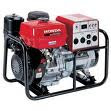
Unfortunately, that is not the company's line of work.

Here is the information I found when I googled the name of the company:


Merchant Information
Generator Systems, Home, Installation, Natural Gas, Whole
Main Website,
Hours: 24/7
Payment: cash/check


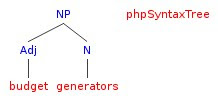
The name of the company can be interpreted as (1) a noun phrase made up of an adjective plus a noun, or (2) a noun phrase consisting of a noun plus noun compound word.
(1)
(2)
It is the multiple meanings of the words "budget" and "generator" that lead to this ambiguity. From the thefreedictionary.com:

generator - a machine that converts mechanical energy into electricity to serve as a power source for other machines.
or
generator - someone who originates or causes or initiates something; "he was the generator of several complaints".

budget n. - allowance, means, funds, income, finances, resources, allocation
or
budget adj. - inexpensive, economy, bargain, sale, reduced, keen, reasonable, low-priced, low-cost, cut-price, economical, cheapo
What kind of budget generator would you prefer?
Related Posts Plugin for WordPress, Blogger...