In yesterday's post about the name of T-Pain's album (THR33 RINGZ), I referred to the use of the "3's" for the "E's" as semiotic. Because semiotics is not a widely known area of linguistics, I thought I should explain a bit more. Semiotics is the scientific study of signs and their linguistic meaning. It is about the relationship between a sign and what it represents. It is about how people determine the meaning of signs. In semiotics a sign is considered anything (a symbol, an icon, a sound, a picture and so on) that stands for another thing.
With the album THR33 RINGZ, semiotics refers to the use of the use of the number "3" as a symbol for the letter "E". Semiotics also examines the relationship between the "3" and the "E" and what it is about the relationship that allows people to determine the intended meaning of the symbol.
Showing posts sorted by relevance for query semiotics. Sort by date Show all posts
Showing posts sorted by relevance for query semiotics. Sort by date Show all posts
Tuesday, December 2, 2008

Thursday, February 5, 2009
The Semiotics of Logos - Obama and Pepsi are Lookalikes
As mentioned in a previous post, semiotics is the branch of linguistics that is concerned with the relationship between a sign and what the sign represents. Semiotics also looks at how people interpret the meaning of signs. In semiotics a sign is considered any type of symbol that stands for another thing. By this definition, a product logo would be considered a sign because the logo stands for the product. People are able to interpret this meaning of the sign because they are conditioned to by advertising.


 The above three logos have many similarities (color, shape, wavey lines). The logo at the left is the new Pepsi logo, the logo at the right is the old Pepsi logo, and the logo in the middle is a logo from President Obama's campaign.


 The above three logos have many similarities (color, shape, wavey lines). The logo at the left is the new Pepsi logo, the logo at the right is the old Pepsi logo, and the logo in the middle is a logo from President Obama's campaign.
I wonder if the creator of this Obama logo intentionally imitated the Pepsi logo so people would associate Obama with Pepsi?
The Pepsi brand was trademarked in 1903 and many people think of Pepsi as an American tradition. Obama certainly does not fit the traditional description of an American president...but maybe with a little help from logos and semiotics.
Friday, April 3, 2009
Bad Advertising - Billboard Semiotics and Pragmatics Fail
Take a close look at the bottom billboard and think about what each symbol might represent and what the sum of these symbols is intended to communicate.

Now, picture driving at 80 miles an hour and trying to figure out not only what each symbol might represent but also what the sum of these symbols is meant to communicate.
As mentioned in a previous post about a billboard pragmatics fail, the context in which a communication occurs plays an important role in a reader's ability to interpret a writer's intended meaning. The context here is the side of an expressway. Any reader in a car going 80 miles an hour or more is going to have an awfully hard time interpreting the writer's intended meaning because at that speed the reader will have a very short time to view the symbols. Not to mention that this doesn't even take into account the possibility of a semi truck obstructing a reader's view.
As for the semiotics fail, the symbols were so poorly executed that my first guess was:
beak + carrot ('s) + rake + "in" + rolling pin
Oh...how wrong I was and and oh...what bad advertising.Upon seeing the billboard a third time I realized - the bird is a duck and the arrow is pointing to its bill, the carrot is supposed to be a surfboard and the last arrow is pointing to a blob of dough, not the rolling pin.
bill + board ('s) + rake + "in" + dough
So the writer's intended meaning was, "billboards rake in dough."
Okay, maybe I should have realized that was a duck the first time but I was driving and reprimanding kids at the same time. Plus I still think the second symbol looks like a carrot everytime I pass it.
Did I mention the apostrophe error? Does the billboard own the rake? The writer should have used a "+ s" not a "'s"
Related posts:
Wednesday, April 6, 2011
Semiotics and Stale Bread
This falls under the following categories:
Where have I been all of my life?
And
You learn something new every day.
My son came home from school last week and asked me if I knew what the plastic tabs on loaves of bread meant. My response was, "yes, they are printed with the sell by dates." Little did I know they are color-coded by delivery date as well.

Snopes.com verified this newly-realized semiotic information for the plastic tabs and the twist ties.
According to Snopes, bread is delivered fresh five days a week to grocery stores: Monday, Tuesday, Thursday, Friday and Saturday. Each day has its own colored twist tie or plastic tab. This color-coding is alphabetical based on the first letter of the color which is coordinated with the order of the days of the week.
Monday - Blue
Tuesday - Green
Thursday - Red
Friday - White
Saturday - Yellow
The main purpose of the color-coding is to help grocery-stocking personnel switchover the bread inventory in a more expedient manner.
Now that I have this new information, I will never purchase a loaf of bread with a blue tab or tie on a Saturday.
###
From a previous post: semiotics is the scientific study of signs and their linguistic meaning. It is about the relationship between a sign and what it represents. It is about how people determine the meaning of signs. In semiotics a sign is considered anything (a symbol, an icon, a sound, a picture and so on) that stands for another thing.
More on semiotics here.
Wednesday, March 6, 2013
The Semiotics of Logos II - More Lookalikes


It reminded me of the similarities between the Obama and Pepsi logos which I previously wrote about in The Semiotics of Logos - Obama and Pepsi are Lookalikes.
Has anyone else ever noticed the resemblance?
It is interesting that for how alike they are, what they represent are quite different endeavors.
Though, I suppose if you get right down to it, they are both about exercising (albeit different parts of the body).
You can read more about semiotics here.
Friday, November 27, 2009
Fun with Semiotics - Assicons
From an e-mail I received (talk about having fun with semiotics).
We all know those cute little computer symbols called 'emoticons' where
:) means a smile and :( is a frown.
Well, how about some 'ASSICONS?'
Here goes:
(_!_) a regular ass
(__!__) a fat ass
(!) a tight ass
(_*_) an ass hole
{_!_} a swishy ass
(_o_) an ass that's been around
(_x_) kiss my ass
(_X_) leave my ass alone
(_zzz_) a tired ass
(_13_) an unlucky ass
(_E=mc2_) a smart ass
(_$_) money coming out of his ass
(_?_) dumb ass
(_~_) a latin ass
(_/_) an Asian ass
(_+_) a French ass
As for me, I am feeling like a (__!__) and a (_zzz_) after yesterday's Thanksgiving feast.
Click here for more about semiotics.
We all know those cute little computer symbols called 'emoticons' where
:) means a smile and :( is a frown.
Well, how about some 'ASSICONS?'
Here goes:
(_!_) a regular ass
(__!__) a fat ass
(!) a tight ass
(_*_) an ass hole
{_!_} a swishy ass
(_o_) an ass that's been around
(_x_) kiss my ass
(_X_) leave my ass alone
(_zzz_) a tired ass
(_13_) an unlucky ass
(_E=mc2_) a smart ass
(_$_) money coming out of his ass
(_?_) dumb ass
(_~_) a latin ass
(_/_) an Asian ass
(_+_) a French ass
As for me, I am feeling like a (__!__) and a (_zzz_) after yesterday's Thanksgiving feast.
Click here for more about semiotics.
Monday, June 18, 2012
More Semiotics of Engineering
For those that may have missed the comments on the recent post titled The Semiotics of Engineering, a reader shared a link that included the following image.


Can anyone guess which college's engineering program this represents?
Thursday, June 7, 2012
The Semiotics of Engineering
My son who is soon to be a high school senior purchased this shirt on a visit to the University of Michigan.

It is such a wonderful example of symbols representing letters (especially for engineers) that I couldn't resist posting a picture of the shirt under the category of semiotics.

It is such a wonderful example of symbols representing letters (especially for engineers) that I couldn't resist posting a picture of the shirt under the category of semiotics.
Friday, September 11, 2009
The Semiotics of College Letters


Dear Dad,
$chool i$ really great. I am making lot$ of friend$ and $tudying very hard. With all my $tuff, I $imply can't think of anything I need. $o if you would like, you can ju$t $end me a card, a$ I would love to hear from you.
Love,
Your $on
__________________________________________________
Dear Son,
I kNOw that astroNOmy, ecoNOmics, and oceaNOgraphy are eNOugh to keep even an hoNOr student busy. Do NOt forget that the pursuit of kNOwledge is a NOble task, and you can never study eNOugh.
Love,
Dad
###
From an e-mail I received...a perfect example of the use of semiotics.
Tuesday, July 12, 2011
Demetri Martin, Linguist???
One of my sons recently purchased comedian Demetri Martin's book, "This is a Book". As I was flipping through it, I noticed that Demetri Martin appears to have a true appreciation for the many aspects of language and how they can be manipulated to humorous effects. Much of his humor involves morphology, syntax, semantics, semiotics, pragmatics and orthography.
Here are some examples from the book.


A Palindrome
A DIALOGUE BETWEEN A MAN AND HIS YOUNG SON. THE MAN IS TRYING TO TEACH THE YOUNG BOY THE NAME OF A PIECE OF FRUIT AND THE DIFFERENCE BETWEEN SINGULAR AND PLURAL:
-Son, say a papaya.
-Papayas.
-No "s."

Here are some examples from the book.
Pragmatics

Syntax
"Nearly 1/2 of all people in the United States are torsos."
Semantics
Semantics
"The boomerang is Australia's chief export (and then import)."
Semiotics
Semiotics

Morphology
A Palindrome
A DIALOGUE BETWEEN A MAN AND HIS YOUNG SON. THE MAN IS TRYING TO TEACH THE YOUNG BOY THE NAME OF A PIECE OF FRUIT AND THE DIFFERENCE BETWEEN SINGULAR AND PLURAL:
-Son, say a papaya.
-Papayas.
-No "s."
Orthography

Thursday, November 24, 2011
Pedestrian Semiotics
To walk, or not to walk: the answer doesn't always look the same.

Here is a link to 23 additional images of pedestrian signals from around the world.
Via Neatorama
###
Semiotics is the scientific study of signs and their linguistic meaning. It is about the relationship between a sign and what it represents. It is about how people determine the meaning of signs. A sign is considered anything (a symbol, an icon, a sound, a picture and so on) that stands for another thing.
Monday, March 23, 2009
More Obama Logo Semiotics

Having previously posted about the semiotics of Obama's campaign logo, I found it interesting that the March 16th issue of Newsweek included a review of the logo that Obama had created for the projects that will be funded by his economic stimulus bill. Interestingly, the new logo was designed by the same firm that created his campaign logo. According to the Newsweek article, "graphic designers say, (this logo), missed the mark. The individual icons - the plant, the gears - are too generic to send a clear message, and they're crammed into too small a space."
Friday, January 15, 2010
A Walk in the Words - Top Ten Posts of 2009
As long as we have been on the subject of lists this week, here is a list of the top ten posts from 2009 on A Walk in the Words.
1. The Semiotics of Logos - Obama and Pepsi are Lookalikes
2. The Evolution of Language - A Terrible, Horrible, No Good, Very Bad Day
3. The Difference Between Lay and Lie
4. Therefor vs Therefore
5. Bad Advertising - Billboard Semiotics and Pragmatics Fail
6. Phrase Etymology - A Pair of Pants
7. Language Peeves - Loose vs Lose
8. Shall We Have Carry Out or Take Away Tonight?
9. Linguistics Cartoon Favorites - Paraprosdokian or Treat
10. Where Was the Girl? - Sentence Ambiguity Diagrammed
1. The Semiotics of Logos - Obama and Pepsi are Lookalikes
2. The Evolution of Language - A Terrible, Horrible, No Good, Very Bad Day
3. The Difference Between Lay and Lie
4. Therefor vs Therefore
5. Bad Advertising - Billboard Semiotics and Pragmatics Fail
6. Phrase Etymology - A Pair of Pants
7. Language Peeves - Loose vs Lose
8. Shall We Have Carry Out or Take Away Tonight?
9. Linguistics Cartoon Favorites - Paraprosdokian or Treat
10. Where Was the Girl? - Sentence Ambiguity Diagrammed
Thursday, June 30, 2011
Sparkler Semiotics - Driving
Hope all that are traveling for the holiday week have a safe and enjoyable trip.

Image from Epic Fireworks Blog

Image from Epic Fireworks Blog
Friday, October 7, 2011


Friday, December 7, 2012
Wine, Texting and Acronyms
Does drinking wine turn texting abbreviations into acronyms?
This is what I saw as I turned the corner at the grocery store the other day -

Even if I had been drinking, I am not sure I could have pronounced "GR8RW" as an acronym. Sure, "GR8" is a texting abbreviation (semiotics included) for "great" and "RW" is an initialization for "red wine", but an acronym these two do not make.
Of course I had to look up this new wine when I returned home.
What I found left me even more confused (and I still hadn't had a drink).
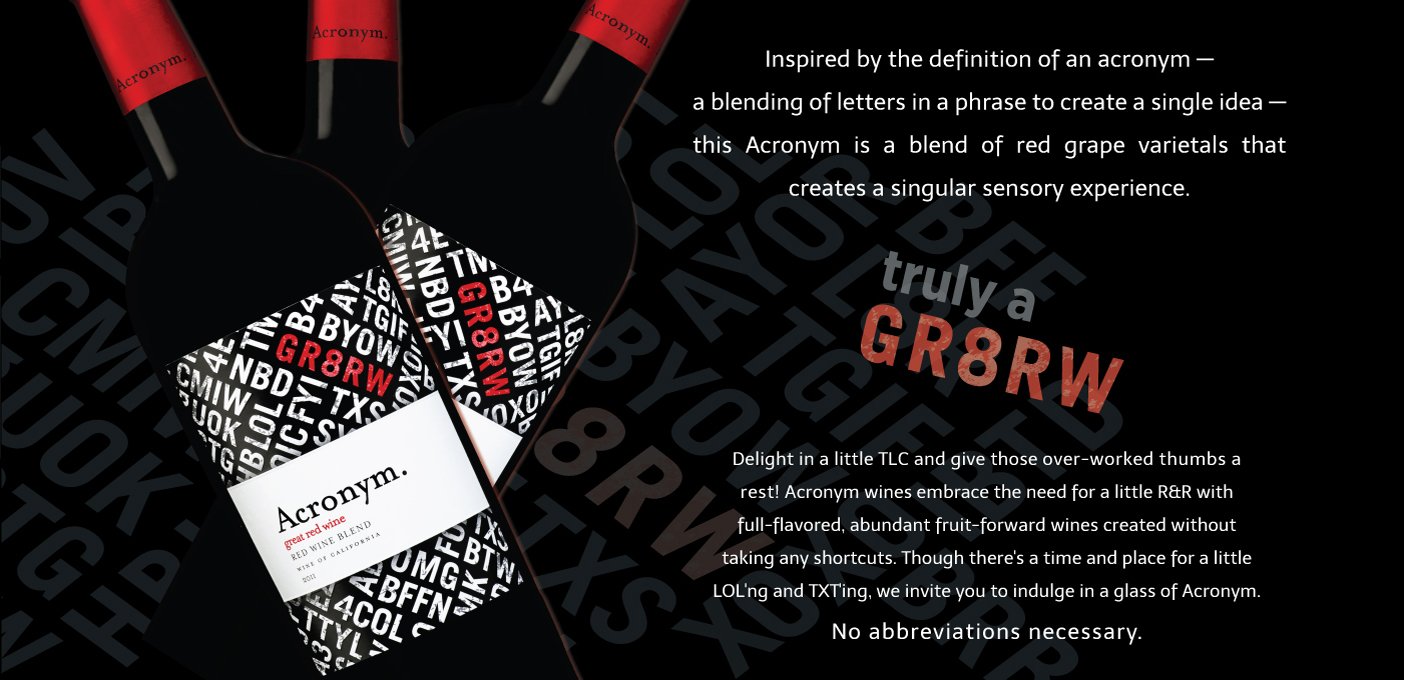
From the ad copy: "...created without taking any shortcuts." "No abbreviations necessary."
Thursday, July 8, 2010
Mixed Messages - Semiotics and Text Message Initialisms Don't Mix

If you see someone
DROWNING
lol
lol
CALL 911
If it weren't for the initialisms created through text message communication, this sign would not have appeared on Fail Blog.
In the old days, the image would have been interpreted semiotically as a swimmer's head and two arms waving for help, not as a comment that suggests people should "laugh out loud" at the sight of a drowning person.
Monday, March 22, 2010
Word Play - License Plate Semiotics
License Plate Quiz
Custom license plates (sometimes called vanity plates) often make use of a combination of letters and numbers to convey a message semiotically.
What do you think this license plate says?

Please click on the comment button to submit your answer.
For more fun with license plates, be sure to check out Vanity Plates: Creepiness in 8 Characters or Less.
Thursday, March 26, 2009
Semiotic Billboard Advertising is Eye Catching
There is a billboard on southbound I-75 near Saginaw that advertises advertising on billboards (A fun topic about which I have previously posted). This particular billboard relies upon semiotics to succinctly deliver its message. The billboard is simply an image of numerous eyeballs being scooped into a net. I was unable to snap a picture of the actual billboard so this is my, admittedly, lame attempt at reproducing it.


Wednesday, June 23, 2010
The Semiotics of Automobiles
I recently ran across a post titled "I don't get it" on the blog Because I Amuse Myself. The reason I ended up at this particular blog post was that I passed a Nissan Cube with a windshield decal that read "The Brave Little Toaster". When I saw the car and its decal I couldn't help but laugh because the car does look rather boxy and I remember Disney's Brave Little Toaster from my children's toddler years. I always wondered if other people thought boxy cars resembled toasters. I got my answer after a few brief moments on the internet. Here is the post:
I don't get it

What's the appeal of the toaster-on-wheels vehicle?As if the Scion xB wasn't enough, now Nissan has joined the box-shaped car club with the not-so-cleverly-named "Cube".

Why? Who goes to a car dealership and thinks, "I want a car that looks like it could toast a giant slice of bread"?
Here is a picture from The Brave Little Toaster:

I also discovered some bumper stickers for sale at various internet sites:


I don't get it
What's the appeal of the toaster-on-wheels vehicle?As if the Scion xB wasn't enough, now Nissan has joined the box-shaped car club with the not-so-cleverly-named "Cube".


Why? Who goes to a car dealership and thinks, "I want a car that looks like it could toast a giant slice of bread"?
###
Here is a picture from The Brave Little Toaster:
I also discovered some bumper stickers for sale at various internet sites:
And then I passed a Ford Flex.


It even has a slot for regular slices of bread and a slot for an extra-wide slice of bread.
Subscribe to:
Comments (Atom)
